
“I had to get my friends reading it!”
“I had to find out what would happen next…”
“It was 3:00 a.m., but I couldn’t stop. It’s such a page turner!”
All fiction authors want to know: what goes into a book readers can’t put down?
As an author (or an editor) it’s easy to focus on mechanics. Does the plot hang together? Is the prose grammatically correct? But, in fact, those aren’t usually the make-or-break qualities. In fact, in the age of self-publishing, readers are likely to overlook a few typos.
This is the question that really makes a difference: Does the book create an enjoyable reader experience?
Recently, a NAIWE member asked me how to achieve this, and I thought I’d share the list I wrote up for her.
1) A niche that works when you don’t
Unless you are already a very successful author, it’s immensely easier to retain reader interest if you have a good niche (or two or three overlapping). A good niche is something readers enjoy reading about even when the story slows down. People who like paranormal activity will want to keep reading about the haunted mansion even if the romance flags a bit in Chapter 2.
A mystery author I worked with recently went from thinking she had no niche to realizing she could write mysteries set in exotic travel locations where unethical rich people get what they deserve. That 1-2 power-punch will make marketing her books so much easier!
2) A main character that wants something
Avoid writing stories where people only act because they are pushed by external circumstances (Why am I solving this case? Because it’s the latest one to cross my desk…) A series-long growth arc draws readers back again and again to see the main character change and improve (increase their skills, build a relationship, heal from trauma, rebel against society’s conventions…) The main character’s INTERNAL MOTIVATION keeps readers hooked on the next book in the series.
3) A main character that struggles
If they’re good at their job (a successful detective, a badass assassin), they must have difficulties in other life areas. Readers can’t relate to a character who does everything well. Every scene where the character succeeds or learns something must create another problem or challenge. This pushes the reader to keep reading to see what happens next. If a scene ends without introducing the next challenge, it’s too easy for readers to put the book down and forget to come back.
4) Enjoyable emotions for readers
Readers get hooked on the cycle of uncertainty / anxiety / danger / stress and then resolution / success / progress / understanding.
- MYSTERIES that don’t sell well are often too caught up in facts or logic and don’t include enough action or emotion.
- ROMANCES have too much miscommunication, uncertainty, or raw physical attraction and not enough genuine emotional chemistry or compatibility.
- SCI-FI or FANTASY books have too much worldbuilding, magic/technology, or history and not enough of the main character’s emotional highs and lows.
People want to feel as they read. Make sure your book runs on emotion. That’s the foundation!
5) Professional developmental editing (not just beta readers)
Until you get the hang of writing books readers can’t put down, you must hire an expert to identify places where the story drags and readers lose interest. A good developmental editor will flag common errors like repetitive obstacles, momentum leaks, undifferentiated dialogue, off-putting stereotypes, and unrealistic depictions of emotions.
Writing sticky stories is a skill. Invest in help and training to learn how to do it. This is crucial if you want to make (more) money as an author. AI is not a substitute for an experienced human expert.
Once you’ve written a sticky story, hooking reader interest requires a few technical points.
6) Get serious about a series
Until your name is well-known, it is much easier to find readers and increase your income with a series. You’ve spent time and effort helping readers fall in love with your world and characters in this book — give them more!
You can certainly experiment with different genres or styles. But once you find something you like writing, it’s a good idea to try publishing 3-4 books that build on a common theme, characters, or world. This makes marketing so much easier, and it can be the key to running successful and lucrative ads on platforms like Amazon. Feel free to contact me if you want to talk about how to leverage this for stories you’re working on.
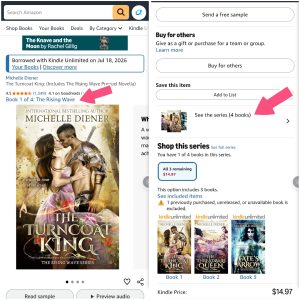
In your series, the books have to be listed in order (see arrows in the Amazon example below). This helps readers easily figure out which book to start with and get hooked on the character’s growth arc. Readers avoid the uncomfortable feeling of starting in the middle where things about the character are assumed but not explained because they were introduced in earlier books.
7) A cover that sells before people read the title
The book cover should identify the niche to help readers easily see why they would be interested — an appealing picture of the main character (because people are attracted to images of people) and/or images of a special interest that readers can identify. If it’s a cozy mystery about a baker, there could be pictures of cookies or a whisk or a mixer. If it’s an American political thriller, there could be a picture of the White House. Professional cover design is a huge factor in convincing readers to start the book in the first place.
We could get way more detailed, but these are the basics. If you’d like to learn more about how to make your work stickier for readers, I would love to talk. Contact me for a free consultation at robin@poolmx.com.
And of course, we can also talk about identifying your best sales energies. That’s Step 2 in putting great stories out into the world.
Happy writing and editing!